The thing that cancels international shows most reliably is not weather, ticket sales, or a van breakdown. It is a border officer deciding that the wrong stamp is in the wrong passport. Visa and work permit questions sit inside every international routing, they take weeks or months to fix, and they cannot be patched on show day.
Here is the part most guides get wrong: "do I need a visa" is actually two questions, and the answer to the first tells you almost nothing about the second.
Entry and Work Are Two Different Questions
Every international date has to clear two separate bars:
- Entry: is this passport allowed to cross the border, and under what status (visa-free, online authorization, consular visa)?
- Work authorization: does that status permit a paid performance?
Visa-free entry covers tourism and usually business meetings. Paid performance is work, and almost everywhere it is governed by separate rules. A passport that breezes through immigration can still be illegal on stage. The reverse also exists: some countries let you in on a visitor status and still permit a short paid gig under a specific exemption.
So for every date on an international routing, check both questions for every person travelling, artists and crew, against every country on the route, not just the port of entry.
The United States: Paid Shows Need a Petition
The US does not let visitor status cover paid performances, full stop. ESTA and B-1/B-2 cover meetings, promo, and conferences; even unpaid showcases at ticketed events are a known border flashpoint.
Touring artists use petition-based classifications, and the petition comes first:
- O-1B for solo artists and band leaders with evidence of extraordinary ability (press, chart history, notable credits)
- P-1B for members of an internationally recognized group performing together
- P-2 for reciprocal exchange programs, the common one being the AFM/CFM exchange for Canadian musicians
- P-3 for performers in culturally unique programs
A US employer, agent, or promoter files the USCIS petition; the consular visa or border admission follows that approval. Because the petition precedes everything else, start months ahead of the first date, not weeks.
Canadian musicians get the same petition requirement with one convenience: no consular visa appointment. The approved petition is presented to CBP at the border or airport, and the P-2 reciprocal exchange run by the American and Canadian Federations of Musicians is the standard route.
Crew are not visitors either. Essential support staff travel on companion categories: O-2 for O-1 support personnel and P-1S/P-2S/P-3S for essential P-visa crew, filed in the same petition cycle. See the glossary entries for the P-2 visa and O-1B visa.
The United Kingdom: One-Off Gigs vs Tours
The UK splits the difference. A visiting professional can do one permitted paid engagement inside Standard Visitor rules: a pre-arranged paid performance for a UK organization, agreed in writing before travel, and finished within one month of arrival. Visa-exempt nationalities do not apply for a visa in advance, but they do need that written invitation, and most now need a UK ETA (a low-cost online authorization) before boarding.
Tours and longer engagements use the Temporary Work, Creative Worker route, which runs on a certificate of sponsorship from a licensed UK sponsor. Eligible non-visa nationals working under three months can often use the Creative Worker concession and enter on the certificate alone, without applying for the visa itself.
A plain Standard Visitor entry covers promo, meetings, and unpaid showcases, not paid shows. And crew generally cannot use the PPE route for technical work: touring crew are treated as creative workers and belong on the sponsor's certificate of sponsorship for the engagement.
One exception worth knowing: the Common Travel Area predates the EU and survives Brexit, so Irish citizens can live and work in the UK without a visa or permit, paid performances included.
Schengen: One Clock, Many Rulebooks
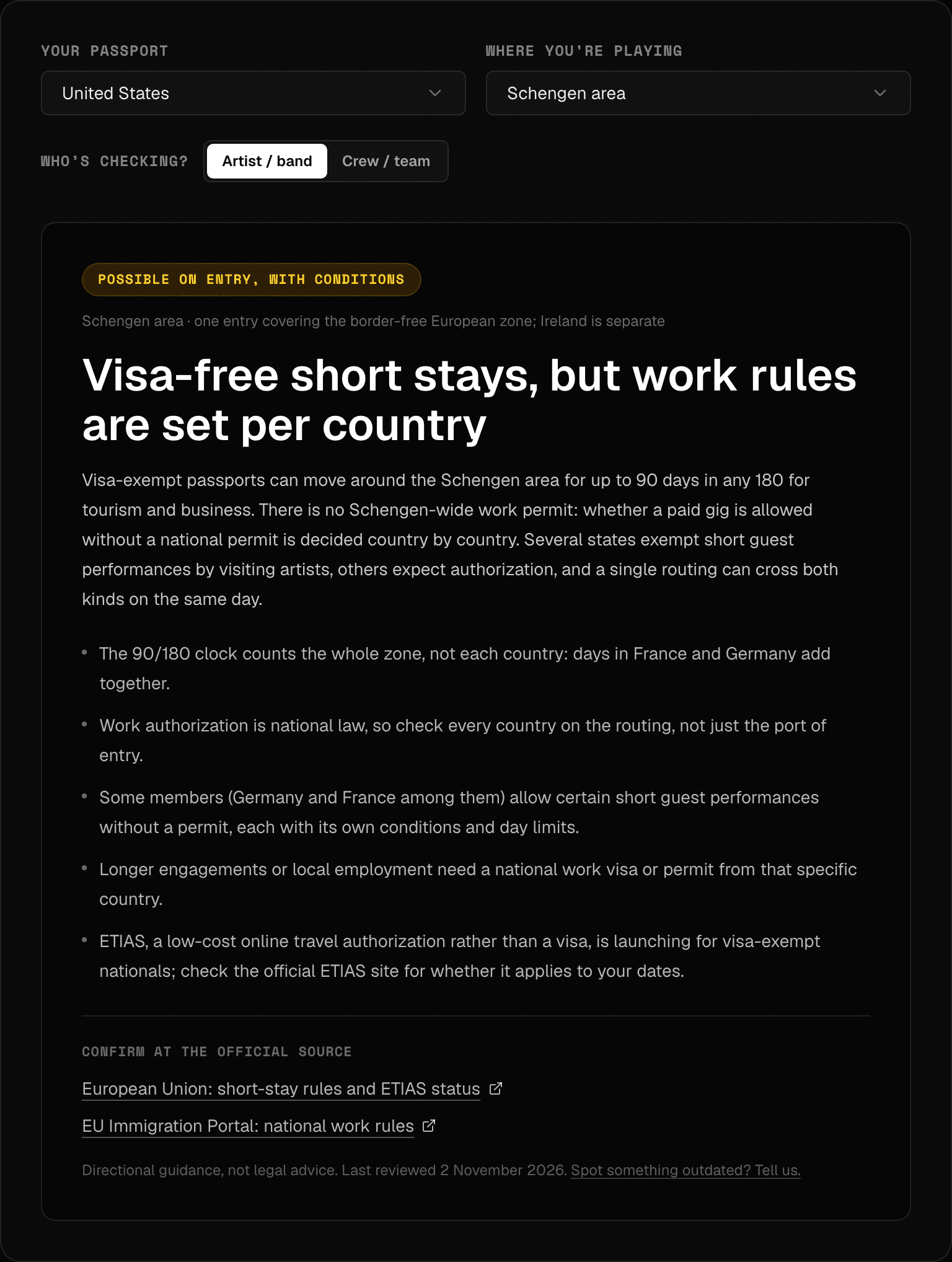
Visa-exempt passports can move around the Schengen area for up to 90 days in any rolling 180, and the 90/180 clock counts the whole zone, not each country: days in France and Germany add together.
That clock answers the entry question. For the work question there is no Schengen-wide permit. Whether a paid gig is allowed without a national permit is decided country by country. Several members, Germany and France among them, exempt certain short guest performances by visiting artists, each with its own conditions and day limits. Others expect authorization. A single routing can cross both kinds on the same day, so check every country on the route.
Longer engagements or local employment need a national work visa or permit from that specific country. And ETIAS, a low-cost online travel authorization rather than a visa, is launching for visa-exempt nationals, so confirm on the official ETIAS site whether it applies to your dates.
Crew ride on the same national rules as the artists, but some countries' exemptions cover only the performers. Check whether technicians and tour managers are included in each country on the routing.
Ireland: Separate From Schengen
Ireland is in the EU but outside Schengen, which cuts both ways: Dublin dates do not spend your 90/180 Schengen allowance, and Schengen days do not count in Ireland.
Visa-exempt nationals (the US, Canada, Australia, New Zealand, Japan and others) can visit for up to 90 days, and a paid performance or event lasting 14 days or less is covered by the performance or tournament route. Visa-required nationalities apply for the short-stay visa in advance; visa-exempt travellers get the equivalent permission assessed at the border with the contract and invitation in hand. Longer runs, or a second paid engagement inside 90 days, go through the Atypical Working Scheme.
UK citizens need nothing at all: the same Common Travel Area lets them live and work in Ireland, paid performances included.
Crew should be covered in the same paperwork as the performers, named in the contract presented at the border or included in the Atypical Working Scheme applications for longer engagements.
Canada: The Friendly Exception
Canada exempts most touring gigs from the work permit requirement entirely. Under the International Mobility Program (Immigration and Refugee Protection Regulations s.186(g)), foreign performing artists and their essential crew can play time-limited engagements without a work permit, and since 2014 that has covered bars, restaurants, and similar venues too.
The carve-outs: it does not cover film, TV, or radio production work, Canadian-based productions, or gigs where you are an employee of the contracting organization.
Work-permit exempt is not entry exempt. Depending on citizenship you may still need an eTA or visitor visa to get in. US citizens get the friendliest version: a valid passport at the border and nothing else.
Whatever your passport, carry the contracts and the itinerary. The border officer makes the call on entry, and paperwork is what makes that call easy.
The Rest of the Routing
The same two-question pattern keeps repeating elsewhere:
- Japan: temporary visitor status does not permit paid performances. Touring artists need Entertainer status of residence, built on a Certificate of Eligibility arranged by the Japanese promoter or inviting organization. Accompanying staff such as tour managers and sound technicians need the same CoE-based status; there is no crew exception.
- Australia: visitor options (Visitor visa, ETA, eVisitor) expressly exclude entertainment work. The Temporary Activity visa (subclass 408) in the Entertainment stream is the standard door, backed by an approved Australian sponsor or supporting organization, usually the promoter. New Zealand citizens are the exception: they receive a Special Category Visa on arrival with full work rights.
- New Zealand: performing artists and entertainment-industry crew need an Entertainers Work Visa (a Specific Purpose or Event visa), with the NZ promoter or employer co-completing the application. Engagements of 14 days or less, or work for accredited employers, skip the industry-referral step.
- Mexico: the 180-day visitor entry does not cover paid shows. The standard route is the Visitante Artista o Deportista permit, applied for by the Mexican promoter or employer at the INM inside Mexico; you cannot self-apply at the border.
Quick Reference: Paid Show Routes by Destination
| Destination | Typical route for a paid show | Watch out for |
|---|---|---|
| United States | Petition-based work visa (O-1B, P-1B, P-2, P-3) | Petition precedes entry; start months ahead |
| United Kingdom | PPE for a single short gig; Creative Worker for tours | Written invitation; UK ETA; crew not on PPE |
| Schengen area | 90/180 visa-free entry; work rules per country | Check every country on the routing; ETIAS launching |
| Ireland | Performance permission for gigs up to 14 days | Outside Schengen; longer runs use Atypical Working Scheme |
| Canada | Work-permit exempt for time-limited gigs | Entry rules still apply; film/TV carve-outs |
| Japan | Entertainer status via Certificate of Eligibility | Crew need the same status; promoter arranges CoE |
| Australia | Subclass 408 Entertainment stream | Visitor visas exclude performing; NZ citizens exempt |
| New Zealand | Entertainers Work Visa | Promoter co-completes; Australians exempt |
| Mexico | INM Visitante Artista permit | Promoter files inside Mexico; no border self-application |
Your Crew Are Not Automatically Covered
A pattern runs through all of this: rules written for "artists and entertainers" do not automatically extend to the people travelling with them.
- US: crew ride companion classifications (O-2, P-1S/P-2S/P-3S) filed in the same petition cycle.
- UK: crew belong on the sponsor's certificate of sponsorship, not the PPE route.
- Schengen: some national exemptions cover only the performers.
- Japan: tour managers and technicians need the same Entertainer status as the band.
- Australia and New Zealand: crew are covered, but under the same sponsored streams, so fold them into the same application.
- Canada: the exemption explicitly covers "essential crew", so keep crew lists aligned with the contracts.
The cheapest visa mistake on a tour is a sound tech turned away because only the band's paperwork was filed.
The Gear Is a Separate Problem
Work permission covers people, not equipment. Instruments, backline, and production gear crossing borders temporarily are a customs question, and the standard answer is an ATA Carnet: a single customs document that avoids duties and deposits at each border for eligible goods in participating countries. Some destinations run their own temporary-import schemes instead, so check before you ship.
A band can have perfect visas and still lose a day to an equipment hold at customs. Treat the carnet decision as part of routing, alongside the work permit checks, not as an afterthought.
How Far Ahead to Start
The ordering matters more than the number: petitions and certificates of eligibility come before visas, and visas come before entry. For the US, the USCIS petition is the long pole and needs months. For the UK Creative Worker route, the sponsor's certificate gates everything. For Japan and Mexico, the local promoter's paperwork gates everything.
Build the visa timeline into the same advance where you confirm production. If the first date is eight weeks out and no petition has been filed, that is a routing problem, not a paperwork detail. Our guides on how to route a tour and how to advance a show cover where this fits in the calendar.
Check Your Exact Routing
Every rule above is the default position, and the exceptions are where tours get hurt. Check each date the same way the venue gets advanced: passport by passport, country by country.
Our free touring visa and work permit checker does exactly that: pick a passport, pick a destination, choose artist or crew, and it shows whether paid shows are visa-free, conditional, or need work authorization, with the official government source linked for every destination and a review date stamped on the page. It covers the US, UK, Ireland, Schengen, Canada, Japan, Australia, New Zealand, Mexico, and the rest of the common touring circuit across Europe, Latin America, Asia-Pacific, and the Middle East and Africa.
Two honest caveats. First, it is directional guidance built from official sources, not legal advice: border officers make the final call, rules change, and for an actual filing you want an immigration attorney or a specialist visa service. Second, it covers short international performances; residency, long relocations, and employed work are different questions entirely.
For the terms used here, see the tour management glossary. Paperwork sorted? TourPro keeps the rest of the advance, the routing, the flights, and the day sheets in one place across web, desktop, and mobile.